Queens Criminal Court case search helps people find public criminal case records filed in Queens County, New York. Many users search for court dates, charges, case status, or warrant information. The official records are maintained by the New York State Unified Court System. Most searches can be done online or at the courthouse clerk’s office. This process gives the public transparency into misdemeanor and felony proceedings. It also helps defendants, families, and employers verify accurate court information quickly.
Queens Criminal Court case search tools provide case details such as docket numbers, arraignment dates, dispositions, and courtroom assignments. These records come from the Queens Criminal Court, which handles criminal matters within Queens County. Users can search by name, case number, or indictment number. Some cases may be sealed under New York law, which limits public visibility. Knowing where and how to search saves time and reduces confusion. This page explains the full process in clear, simple steps for anyone needing reliable court record information.
What Is the Queens Criminal Court?
The Queens Criminal Court is the primary misdemeanor court serving Queens County in New York City. It handles arraignments, violations, and most non-felony criminal cases filed within the borough. The criminal court Queens NY residents refer to is part of the larger New York City Criminal Court. That court operates under the statewide authority of the New York State Unified Court System, which manages all trial and appellate courts across New York.
How the Borough Court System Works
New York City has five boroughs, and each borough has its own Criminal Court location. Queens is one branch of this borough court system. Even though each borough has its own courthouse, all operate under the same citywide structure.
Queens Criminal Court mainly handles:
- Misdemeanor offenses
- Violations and infractions
- Initial appearances for felony charges
- Bench warrants
- Bail hearings
Felony charges begin in Criminal Court with an arraignment. After arraignment, serious cases often move to the Queens County Supreme Court if a grand jury files an indictment.
What Happens at Arraignment?
Arraignment is the first court appearance after arrest. During this hearing:
- The judge reads the charges
- The defendant enters a plea
- Bail may be set
- The next court date is scheduled
Role in Queens NY Court Records
Queens Criminal Court generates official Queens NY court records for every case filed. Most local court records are public unless sealed under state law. That transparency allows defendants, attorneys, employers, and family members to review case status through court databases or in person. These records include:
- Case summaries
- Disposition details
- Court dates
- Plea information
- Sentencing outcomes
How the Queens Borough Court System Works
The Queens borough court system is structured to handle criminal cases from arrest through final resolution. It divides responsibility between Criminal Court and Supreme Court based on the severity of the charges and legal jurisdiction. Queens operates within the larger New York City Criminal Court and the New York State Unified Court System. Each court has a defined role, and cases move through the system in a predictable sequence.
For official court information, users can visit the New York Courts website:
https://nycourts.gov
Criminal Court vs Supreme Court in Queens
Many people confuse Supreme Court with Criminal Court. In New York, “Supreme Court” is actually the higher trial court.
Here is how they differ:
| Court | Handles | Case Identifier |
|---|---|---|
| Queens Criminal Court | Misdemeanors, violations, arraignments for felonies | Docket Number |
| Queens County Supreme Court (Criminal Term) | Felony trials and indictments | Case Index Number |
Criminal Court is often called the misdemeanor court. It handles lower-level offenses and conducts arraignments for felony charges. If prosecutors seek an indictment through a grand jury, the felony case transfers to the Queens County Supreme Court. At that stage, the case receives a new case index number, replacing the original criminal docket Queens number used in Criminal Court. This transfer explains why some searches require checking both courts.
How a Case Moves Through the System
A criminal case in Queens usually follows this path:
- Arrest occurs
- Defendant appears in Criminal Court for arraignment
- Judge sets bail or releases defendant
- Case remains in Criminal Court (misdemeanor) or
- Case moves to Supreme Court (felony indictment)
- Case resolves through plea, dismissal, or trial
Each step generates new entries in the criminal docket Queens system. Court calendars update with adjournments, motions, and dispositions.
Role of the Queens County Clerk
The Queens County Clerk plays a record-keeping role within the borough court system. This distinction matters during a queens criminal court case search. If a felony case does not appear in Criminal Court results, checking county clerk records through the Supreme Court system may provide answers. Criminal Court records are handled separately within the NYC Criminal Court system. Yet once a felony case reaches Supreme Court, the County Clerk becomes the primary custodian of official filings.
The County Clerk:
- Maintains official Supreme Court case files
- Stores felony case index numbers
- Processes certified document requests
- Preserves archived county clerk records
How to Perform a Queens Criminal Court Case Search Online
A queens criminal court case search can be completed online through official New York court databases. Most people use the state’s eCourts system to run a queens criminal court lookup by defendant name or docket number.
The official platform is managed by the New York State Unified Court System. It provides public access to criminal docket Queens entries, court dates, and case outcomes. Users can begin their search at the official site:
https://iapps.courts.state.ny.us/webcrim_attorney/AttorneyWelcome
General public access for Queens NY court records and other New York courts:
https://iapps.courts.state.ny.us/webcivil/ecourtsMain
Official search portal for cases filed with the Queens County Clerk’s office:
https://iapps.courts.state.ny.us/webccos/queenscc/indexSearch
General resource explaining where and how court records are accessed statewide:
https://www.nycourts.gov/Courthelp/goingtocourt/records.shtml
While not required for searching, eTrack lets users follow updates on cases they want to monitor:
https://iapps.courts.state.ny.us/webcivil/etrackLogin
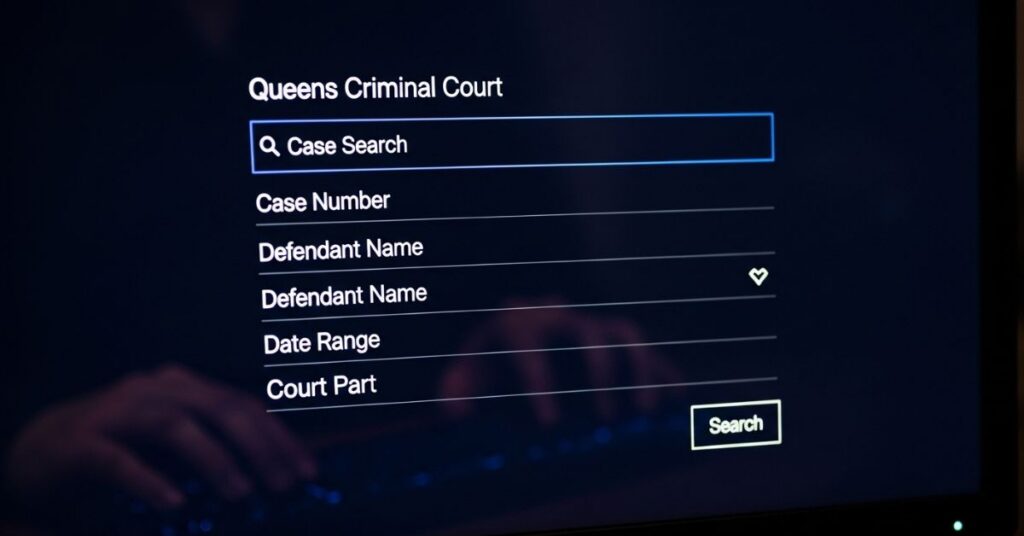
Search by Defendant Name
A defendant name search is the most common method in a queens criminal court lookup. This option works well when the docket number is unknown.
Follow these steps:
- Visit the WebCriminal portal.
- Accept the terms of service.
- Select “Search by Defendant Name.”
- Enter the defendant’s first and last name.
- Choose Queens County from the court filter.
- Click search.
Results will display matching Queens NY court records. Each listing typically shows:
- Defendant’s full name
- Date of birth (partial)
- Criminal docket Queens number
- Charges filed
- Court part
- Next court date
Users should double-check spelling before running a search. Even a minor typo can prevent results from appearing. Trying variations of a name can help if no match appears.
Search by Docket Number
A case number search produces faster and more precise results. Each case filed in Queens Criminal Court receives a docket number, which acts as its unique identifier.
Steps to search by docket number:
- Open WebCriminal.
- Select “Search by Docket Number.”
- Enter the full docket number exactly as listed.
- Confirm Queens County is selected.
- Submit the search.
This method immediately pulls up the specific criminal docket Queens record. It eliminates confusion caused by similar names.
Docket numbers usually appear on court paperwork, bail receipts, desk appearance tickets, or attorney filings. If a case has moved to felony indictment, it may receive a Supreme Court case index number. In that situation, users may need to check the Supreme Court database.
Checking Case Status and Disposition
After locating a case, users often want to perform a case status check. The WebCriminal system displays whether a case is open, pending, disposed, or sealed. A disposition does not always mean conviction. Many Queens NY court records show dismissals or reduced charges. Reading the full entry helps clarify whether penalties were imposed. Users should review each line of the case history, since multiple court appearances may appear before final resolution. Checking disposition data carefully prevents misunderstandings that can affect employment screenings or background checks.
Common case status terms include:
- Active – Case remains ongoing
- Adjourned – Next court date scheduled
- Disposed – Case has reached a final outcome
- Bench Warrant Issued – Court has issued a warrant
Disposition details explain how the case ended. For example, a case may show:
- Plea agreement
- Dismissal
- Conviction
- Adjournment in contemplation of dismissal (ACD)
Viewing Court Calendars
The eCourts platform also allows users to view the court calendar for Queens Criminal Court. This feature helps confirm upcoming appearances. Court calendars update frequently, often the day before scheduled appearances. Users should check the calendar close to the hearing date for accuracy. If a case does not appear on the calendar, it may have been adjourned or reassigned to another part. Calling the clerk’s office can confirm scheduling if online results appear unclear.
Steps to view court calendars:
- Access the eCourts calendar section.
- Select Queens Criminal Court.
- Choose the court part or judge.
- Enter the date range.
- Search the listing.
The court calendar shows:
- Scheduled cases
- Courtroom assignments
- Appearance times
- Defendant names
How to Request Queens NY Court Records In Person
Anyone can request Queens NY court records in person by visiting the appropriate courthouse and submitting a record request at the clerk’s office. The process is straightforward, though the steps differ slightly depending on whether the case was handled in Criminal Court or Supreme Court. Queens Criminal Court records are maintained by the New York City Criminal Court, while felony case files in Supreme Court are maintained by the Queens County Clerk. Knowing which court handled the case saves time and avoids delays.
Confirm the Correct Court
Before visiting the courthouse, confirm:
- Whether the case was a misdemeanor or felony
- The docket number or case index number
- The approximate year of the case
Misdemeanor cases remain in Criminal Court. Felony cases that went to indictment are filed with the Queens County Clerk as part of Supreme Court records.
If unsure, conduct an online search first to verify case details.
Visit the Courthouse
Queens Criminal Court is located in Kew Gardens, Queens. Supreme Court criminal records are also handled in the same borough but through a different clerk division.
Bring:
- Government-issued photo ID
- Case number (if available)
- Defendant’s full name
- Date of birth (if known)
Check clerk office hours before arriving. Most offices operate Monday through Friday during standard business hours, excluding holidays.
Complete a Record Request Form
At the clerk’s window, staff will provide a record request form. This form typically asks for:
- Defendant name
- Case number
- Year of case
- Type of document requested
Common requests include:
- Case summaries
- Court minutes
- Sentencing records
- Disposition documents
If the case is public and not sealed, the clerk will locate the file.
Request Certified Copies
If official proof is required for employment, immigration, or licensing purposes, request certified copies. Certified documents carry a court seal confirming authenticity.
Copy fees apply. Fees vary depending on:
- Number of pages
- Certification type
- Search time required
Criminal Dockets in Queens
A criminal docket Queens record is the official timeline of a criminal case filed in Queens Criminal Court. It lists every major event in the case, from arraignment through final disposition.
Many people use a queens criminal court lookup to view the docket sheet online. The docket sheet acts like a case history log. It shows what happened, when it happened, and what may happen next.
What Information Appears on a Criminal Docket?
Criminal dockets update throughout the life of a case. Early entries often focus on arraignment and bail decisions. Later entries may show plea negotiations, suppression hearings, or trial scheduling. Once the case ends, the docket lists the final disposition, such as dismissal, conviction, or adjournment in contemplation of dismissal. Reading the full docket sheet gives a clearer picture than looking at a single case status label.
A typical docket sheet includes:
- Defendant’s name
- Docket number
- Charges filed
- Arraignment date
- Hearing dates
- Motions filed
- Case filings
- Bail status
- Disposition
Each court appearance creates a new entry. For example, if a defense attorney files a motion to dismiss, the docket will reflect that filing and list the scheduled motion hearing.
Why Docket Details Matter
The docket sheet helps confirm:
- Whether the case is still active
- When the next court date is scheduled
- What legal motions are pending
Are Queens Criminal Court Records Public?
Most Queens NY court records are public and available through online databases or in-person requests. New York follows open court principles, which allow public access records for criminal proceedings. Public access records promote transparency in the criminal justice system. Employers, journalists, and community members can review case information to verify outcomes. At the same time, public visibility does not mean unlimited access to sensitive documents. Certain personal data, such as full Social Security numbers or protected witness information, is restricted even in public files.
That said, not every case remains visible to the public.
What Is Publicly Available?
Public local court records often include:
- Defendant name
- Charges
- Court dates
- Docket number
- Disposition
- Sentencing details
Anyone can search these records through official court tools unless the case has been sealed.
What Records Are Sealed?
Some cases qualify as sealed records under New York law. Sealed cases do not appear in standard public searches.
Common examples include:
- Cases dismissed under Criminal Procedure Law §160.50
- Certain marijuana-related offenses
- Adjournment in contemplation of dismissal (after dismissal)
- Youthful offender adjudications
Expungement vs Sealing
New York does not offer traditional expungement for most criminal convictions. Instead, individuals may petition to seal certain eligible convictions after a waiting period. Sealing hides the case from most public background checks. Law enforcement agencies may still retain limited internal access.
Queens County Clerk vs Criminal Court Clerk?
Many people confuse the Queens County Clerk with the clerk for criminal court Queens NY. They serve different functions within the borough court system. The Queens County Clerk primarily maintains Supreme Court filings. The Criminal Court clerk handles misdemeanor case files and arraignment records.
Criminal Court Clerk Responsibilities
The Criminal Court clerk:
- Maintains misdemeanor docket records
- Stores case filings for violations and lesser offenses
- Provides certified copies of Criminal Court documents
- Updates court calendars
These records relate to cases that remain within Criminal Court jurisdiction.
Queens County Clerk Responsibilities
The Queens County Clerk manages:
- Supreme Court felony case index numbers
- Indictment filings
- Supreme Court motions and trial records
- Document certification for Supreme Court cases
- Archived county-level records
FAQs – Queens Criminal Court Case Search
Below are common questions about a Queens criminal court case search, written in a clear, schema-ready Q&A format. These answers address public search tools, criminal docket Queens records, and Queens NY court records procedures.
How do I look up a criminal case in Queens NY?
To look up a criminal case in Queens NY, use the official WebCriminal system provided by the New York State Unified Court System. Visit https://iapps.courts.state.ny.us/webcrim_attorney/AttorneyWelcome and search by defendant name or docket number.
Users can filter results by Queens County to narrow the search. The system will display case details such as charges, hearing dates, criminal docket Queens number, and case status. If the case is a felony that moved to Supreme Court, users may need to search using a case index number instead.
Is Queens Criminal Court case search free?
Yes, a Queens criminal court case search is free when conducted through official court websites. WebCriminal and eCourts tools do not charge a fee for public case lookups.
Fees only apply when requesting physical documents, certified copies, or archived files in person. Online viewing of docket sheets, court calendars, and case summaries remains free of charge.
Can I search without a docket number?
Yes, users can perform a queens criminal court lookup without a docket number by using a defendant name search. The WebCriminal system allows searches by first and last name.
Entering the correct spelling and selecting Queens County improves accuracy. If multiple results appear, reviewing date of birth and charge type helps identify the correct Queens NY court records entry.
How do I find a court date and check case status?
To find a court date, conduct a case status check through WebCriminal. After locating the case, the docket sheet will list the next scheduled appearance under hearing dates or court calendar entries.
Case status labels may include:
- Active
- Adjourned
- Disposed
- Bench Warrant Issued
Reading the full docket sheet gives more detail than the summary line. The court calendar feature also allows searches by date and courtroom to confirm scheduled appearances.
How do I get certified copies of Queens NY court records?
Certified copies must be requested in person at the appropriate clerk’s office. Misdemeanor records are handled by the Criminal Court clerk. Felony Supreme Court records are maintained by the Queens County Clerk.
Bring valid photo ID and the case number if available. Complete a record request form and pay the required copy fees. Certified copies include an official court seal for legal or employment use.
What is the difference between a docket number and an index number?
A docket number is assigned to cases filed in Queens Criminal Court, typically misdemeanors or felony arraignments. An index number applies to felony cases filed in Supreme Court after indictment.
When a felony moves from Criminal Court to Supreme Court, the docket number is replaced by a case index number. Searching the correct number type is important for accurate results.